
For India,is BRICS worth it
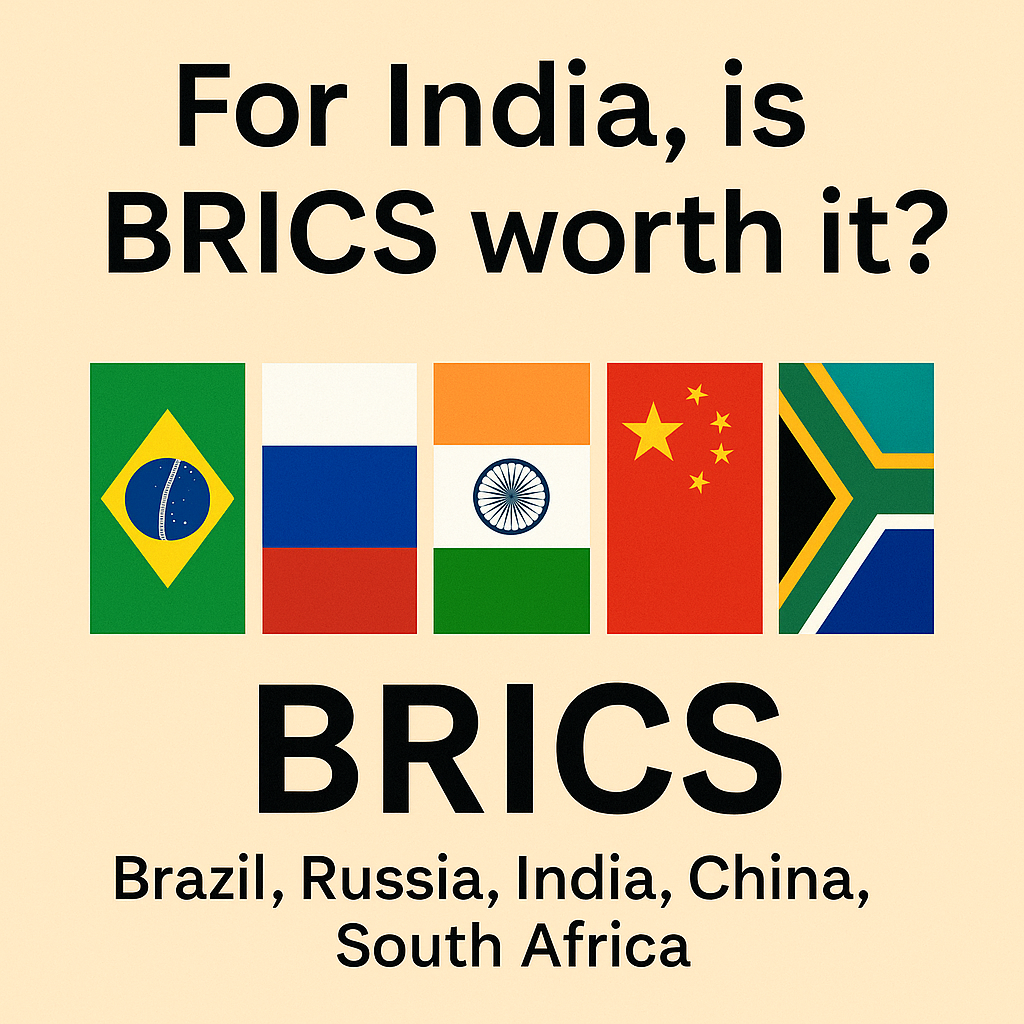
BRICS: Is It Really Benefiting India?
Whenever we hear about BRICS — Brazil, Russia, India, China, and South Africa — it sounds like a powerful group.
Let’s be real: BRICS looks impressive on paper. Five major countries coming together to challenge Western dominance sounds like a great idea.
But the real question is: Is BRICS actually delivering anything substantial for India? Or are we simply part of a group that makes big speeches but delivers very little?
1. What Was the Idea Behind BRICS?
India didn't join BRICS just for fun or a few trade deals.
It joined with a larger vision: to build a collective voice for the Global South — countries that are often overlooked or underrepresented in global politics.
For India, BRICS was an opportunity to establish itself not just as a regional power but as a serious global player.
To some extent, BRICS has helped India achieve that.
It has provided a platform where India can sit alongside leaders like Putin and Xi Jinping and discuss important issues such as:
- International finance
- Economic development
- Technology
- Climate change
- Global governance
2. What's Working in India's Favour?
There are a few areas where BRICS genuinely benefits India.
The New Development Bank (NDB)
The New Development Bank provides funding for infrastructure and development projects. It offers India an additional source of financing beyond traditional institutions like the IMF and World Bank.
India has benefited from this institution.
Informal Diplomacy
BRICS summits give India opportunities to hold bilateral discussions with global leaders.
Sometimes, these informal conversations produce more meaningful results than formal speeches and diplomatic statements.
Global Credibility
Being part of BRICS strengthens India's position in the non-Western world.
It also gives India another platform to push for reforms in international institutions such as the United Nations and the WTO.
So yes, BRICS has value. But only to a certain extent.
3. What's NOT Working for India?
Let's not ignore the elephant in the room: China.
India and China have tense relations because of:
- Border conflicts
- Trade imbalances
- Competition for regional influence and dominance
And yet, both countries sit at the same table.
Worse, China has considerable economic and diplomatic influence within BRICS and often pushes its own agenda.
But India understands this. And that's precisely why it remains part of the group: to balance China's influence from within.
Economically, BRICS has also been somewhat disappointing:
- No comprehensive free trade agreement.
- Limited progress towards meaningful economic integration.
- No game-changing economic decisions that have transformed trade relations between member countries.
4. India's Real Strategy: Strategic Patience
So, why doesn't India simply walk away?
Because doing so could give China even more freedom to shape the organisation according to its interests.
Staying in BRICS allows India to maintain its influence, participate in important discussions and protect its strategic interests.
India's foreign policy is not dependent on a single organisation. It actively participates in multiple international groupings:
- BRICS: Engagement with emerging economies.
- G20: Participation in global economic governance.
- SCO: Regional cooperation and security.
- QUAD: Cooperation with like-minded countries in the Indo-Pacific.
This is an example of strategic autonomy and smart diplomacy.
Let's not forget the soft power angle.
BRICS gives India an opportunity to present itself as a responsible and mature voice of the Global South. And that matters in today's changing world order.
5. So, Is BRICS Worth It for India?
Honestly? Yes, but only if India remains alert and protects its national interests.
BRICS won't deliver magical results overnight. However, it gives India space to:
- Strengthen international partnerships.
- Raise its voice on global issues.
- Promote a multipolar world order.
- Shape discussions on global governance.
- Maintain diplomatic engagement with competing powers.
The key is to use this platform wisely.
BRICS is far from perfect, and India should never compromise its national interests just to maintain unity within the group.
In today's world, having more seats at the table is always better than watching from the outside.